
WHAT THE LAW ACTUALLY DOES
A legal backstop, not just guidance.
Awaab's Law is a legal requirement that sets fixed timeframes for social landlords to investigate and fix hazards in their properties, starting with damp and mould. It does not replace an inspection or a survey. It sets the clock that inspection has to happen within, and the clock that repair work has to start within, once a hazard is confirmed.
The distinction matters. Before this law, a social landlord's duty to keep a property in good repair was real but its timing was loosely enforced in practice. Awaab's Law converts part of that duty into a fixed, legally enforceable schedule: investigate within so many working days, begin repair within so many more, and treat an emergency as an emergency.
Why the law exists
The law is named after Awaab Ishak, a two year old boy who died in 2020 from a respiratory condition linked to prolonged exposure to mould in his family's social housing flat. His parents had reported the mould to their landlord repeatedly over roughly three years before his death, without the underlying cause being resolved.
The findings that followed identified the response, not just the mould itself, as the failure: reports were not acted on quickly enough, and there was no legal deadline forcing a different outcome. Awaab's Law was introduced to close that gap, first for the social sector, with the private rented sector expected to follow.
Phase 1: damp and mould
Phase 1 has applied since 27 October 2025 and covers hazards relating to damp and mould specifically. It applies to registered providers of social housing in England, meaning local authorities and housing associations, for properties let under a tenancy agreement. Long leaseholds and shared ownership arrangements sit outside it.
Phase 2: the wider set of hazards
From 30 November 2026, the same investigate and repair timeframes extend beyond damp and mould to cover other significant hazards:
- Excess cold and excess heat
- Falls on level surfaces
- Structural collapse
- Fire and electrical hazards
- Domestic hygiene hazards
The mechanism does not change between phases. A significant hazard in any of these categories has to be investigated within 10 working days and repair work has to begin within 5 working days of that investigation, with the 24 hour emergency standard sitting above both.
Where the private rented sector stands
What is expected, based on published direction rather than a confirmed timetable, is a similar phased approach to the one used for social housing, likely starting with damp and mould before extending to the wider hazard set. The specific hazards in scope and the exact timeframes for private landlords will be set out when that secondary legislation is published, and may not be identical to the social housing rules.
What this means in practice
For a social landlord, managing agent or facilities team already covered by Phase 1, the practical requirement is straightforward to state and harder to deliver under pressure: a genuine investigation, not a guess from a description over the phone, completed inside 10 working days, with a written record of what was found and why, and a clear route into repair rather than a second delay while a different contractor is found.
For private landlords and letting agents not yet covered, the direction of travel is clear even without a date attached to it. Building the same habits now, a proper survey, a written finding, a fast route from finding to authorised repair, means the eventual extension of the law is a formality rather than a scramble.
TIMELINE
How the phases stack up.
27 October 2025
Phase 1 takes effect. Significant damp and mould hazards: 10 working days to investigate, 5 working days to begin repair. Emergency hazards: 24 hours.
30 November 2026
Phase 2 takes effect. The same timeframes extend to excess cold and heat, falls on level surfaces, structural collapse, fire and electrical hazards, and domestic hygiene.
Not yet confirmed
Private rented sector extension. The legal power exists in the Renters' Rights Act 2025, but secondary legislation and a start date have not been published.
Ongoing
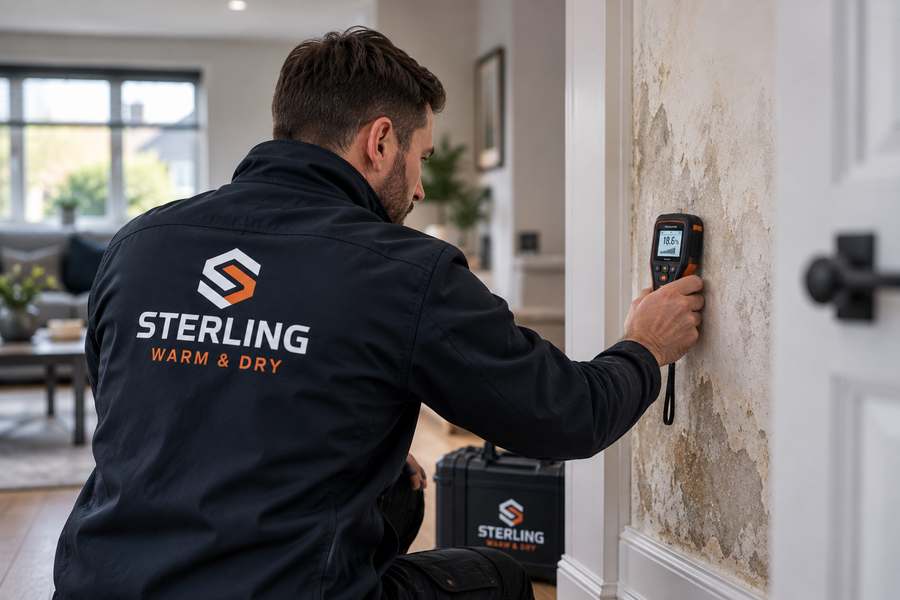
Sterling investigates and evidences damp, mould, leaks and cold before any repair is agreed, in line with the same cause before remedy standard the law is built around.
COMMON QUESTIONS
Questions about Awaab's Law
What is Awaab's Law in simple terms?
It is a legal requirement, not just guidance, that sets fixed timeframes for social landlords to investigate and fix hazards such as damp and mould. Where it applies, a landlord who does not act within those timeframes is failing a legal duty, not just falling short of good practice.
Who does Awaab's Law currently apply to?
Registered providers of social housing in England, meaning local authorities and housing associations, for properties let under a tenancy agreement. It does not currently cover long leaseholds or shared ownership arrangements, and it does not yet apply to private landlords.
What counts as an emergency hazard?
A hazard that presents an imminent and significant risk of harm to a tenant's health or safety. Under Phase 1, an emergency hazard must be investigated and made safe within 24 hours.
What are the timeframes for damp and mould specifically?
For damp and mould that presents a significant risk, a landlord must investigate within 10 working days and begin repair work within 5 working days of that investigation. An emergency damp or mould hazard must be made safe within 24 hours.
What does Phase 2 add?
From 30 November 2026, the same investigate and repair timeframes extend to other significant hazards: excess cold and excess heat, falls on level surfaces, structural collapse, fire and electrical hazards, and domestic hygiene hazards.
Does Awaab's Law apply to private landlords yet?
Not yet. The Renters' Rights Act 2025 gives the government the legal power to extend Awaab's Law to the private rented sector, but that extension needs separate secondary legislation before it takes effect. No implementation date has been confirmed at the time of writing.
What should a private landlord or letting agent do in the meantime?
Treat the current social housing timeframes as a strong indication of where enforcement is heading, and build the evidence habits now: a proper investigation rather than a guess, a written record of what was found and when, and a clear route from finding to repair.
Get ahead of the deadline.
Whether or not Awaab's Law applies to a property yet, an evidence led survey is the fastest way to know what is actually happening and what needs to happen next.
Book a surveyCall 07415 909211