
THE STERLING APPROACH
Start with the cause, then build the route to resolution.
Not every wet building in York is caused by the river. Plumbing failures, roof defects and defective rainwater goods account for a significant share of the water damage instructions Sterling takes on across the city, and each needs to be confirmed rather than assumed from the property's location alone.
Where a property is listed or traditionally built with lime mortar and solid walls, drying has to be managed carefully. Sealing a wet solid wall behind modern materials too early can trap moisture that would otherwise evaporate, so Sterling's monitoring is used to confirm a genuine drying endpoint before any reinstatement begins.
The first priority is control
Active water should be made safe and the source controlled as quickly as practicable. The affected area can then be assessed to understand where water has travelled and which materials can remain, which need opening up and which may need removal.
Drying is a measured process
Drying is not simply leaving equipment in a room. The approach depends on the materials, water pathway, environmental conditions and access to wet fabric. Baseline readings and monitoring provide evidence of progress and help determine when reinstatement is appropriate.
Restore after the moisture problem is understood
Prematurely closing wet assemblies can trap moisture and create secondary problems. Reinstatement should follow the drying and condition evidence, with targeted repair and making good coordinated around the original incident.
COMMON CAUSES IN YORK
The water damage causes we most often confirm in York
River and surface water flooding
Properties closer to the Ouse and the Foss carry a higher exposure to river and surface water flooding, particularly during sustained heavy rainfall.
Plumbing failures in older and listed buildings
Older pipework routed through solid walls and traditional floor build-ups can fail without an obvious external sign, making early detection harder.
Roof and rainwater goods on historic properties
Ageing lead work, valleys and guttering on period roofs are a recurring source of slow water ingress that surfaces well away from the actual defect.

DOCUMENT THE DECISION
Make the evidence useful after the visit.
For involved or managed property instructions, the site record can connect photographs, observations and relevant measurements to a clear recommendation and next stage.
Professional reporting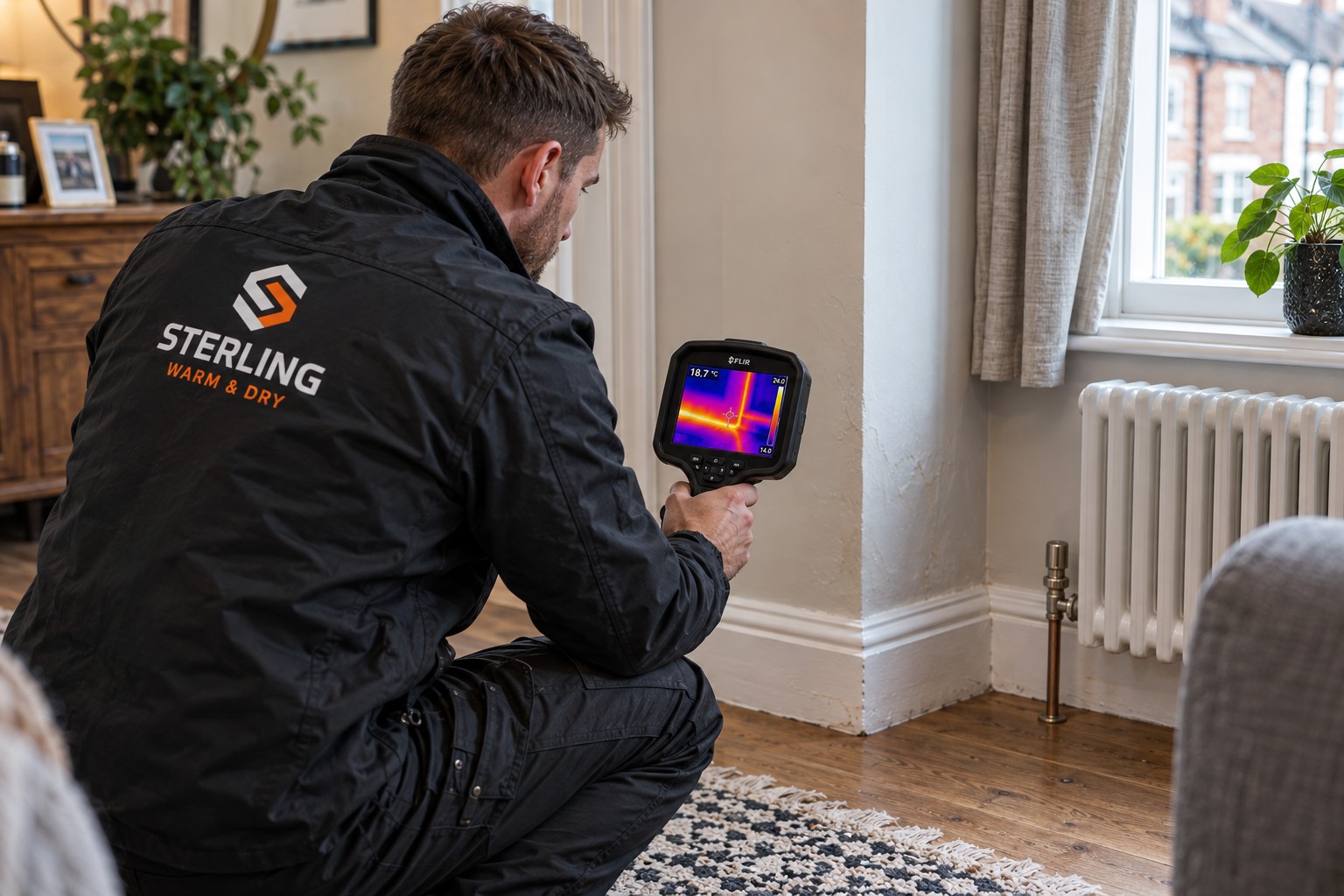
YORK
Why drying evidence matters more in a historic city
A large proportion of York's building stock predates modern damp-proof and moisture-control standards, and a meaningful share is listed. That changes what a sensible drying and repair programme looks like: work has to reflect the construction and any listed building constraints, not follow a standard modern specification. Sterling's monitoring gives a clear, evidenced point at which reinstatement can begin without disturbing historic fabric unnecessarily.
Covering the city centre, Fulford, Clifton, Acomb and the areas closest to the Ouse and the Foss.
Book / report an issueCOMMON QUESTIONS
Questions about this service
Does being near the Ouse or the Foss mean my water damage is flood related?
Not necessarily. Proximity raises the likelihood, but plumbing failures and roof defects are common regardless of location, and Sterling investigates rather than assumes the cause from geography alone.
Can you work on listed buildings in York?
Yes. We can survey and manage drying on listed and traditionally built properties, with any recommended repair reflecting the building's construction and relevant listed building constraints.
How do you avoid damaging historic fabric during drying?
Monitoring provides evidence of the drying endpoint before any opening up or reinstatement is agreed, which reduces the risk of unnecessary disturbance to historic material.
“Our downstairs ceiling was wet after heavy rain and we were worried about what taking it down would mean for a listed building. Sterling explained what needed opening up and what didn't, which mattered a lot to us.”
Eleanor · Homeowner, York city centreStart with the building problem.
Tell Sterling what you can see, when it started and whether water is active now. We can establish the most appropriate investigation or response pathway.
Book / report an issueCall 07415 909211