
THE STERLING APPROACH
Start with the cause, then build the route to resolution.
A burst pipe in a converted mill flat behaves differently to an escape of water in a stone-built terrace, and differently again to surface flooding near the Aire. Sterling starts by establishing which of these is actually happening before deciding how the building should be dried and put back together.
Leeds has also invested heavily in flood defence along the Aire corridor, including the ongoing Leeds Flood Alleviation Scheme protecting areas around Kirkstall and the city centre. That reduces river flood risk for many properties, but it does not reduce the far more common cause of water damage across the city: a failed appliance connection, a split pipe behind a wall, or water tracking through a shared floor in a converted building.
The first priority is control
Active water should be made safe and the source controlled as quickly as practicable. The affected area can then be assessed to understand where water has travelled and which materials can remain, which need opening up and which may need removal.
Drying is a measured process
Drying is not simply leaving equipment in a room. The approach depends on the materials, water pathway, environmental conditions and access to wet fabric. Baseline readings and monitoring provide evidence of progress and help determine when reinstatement is appropriate.
Restore after the moisture problem is understood
Prematurely closing wet assemblies can trap moisture and create secondary problems. Reinstatement should follow the drying and condition evidence, with targeted repair and making good coordinated around the original incident.
COMMON CAUSES IN LEEDS
The water damage causes we most often confirm in Leeds
Escape of water in converted mills and HMOs
Shared risers, multiple kitchens and bathrooms stacked above each other, and plumbing altered during conversion all raise the chance of a leak affecting more than one unit.
Plumbing failures in Victorian terraces
Older pipework, and repairs carried out over many years by different tradespeople, are a common source of hidden escapes behind plaster and under floors.
Surface water and drainage close to the Aire
Properties nearer the river corridor and older culverted becks can be exposed to surface water even where formal flood defences are in place.
DOCUMENT THE DECISION
Make the evidence useful after the visit.
For involved or managed property instructions, the site record can connect photographs, observations and relevant measurements to a clear recommendation and next stage.
Professional reporting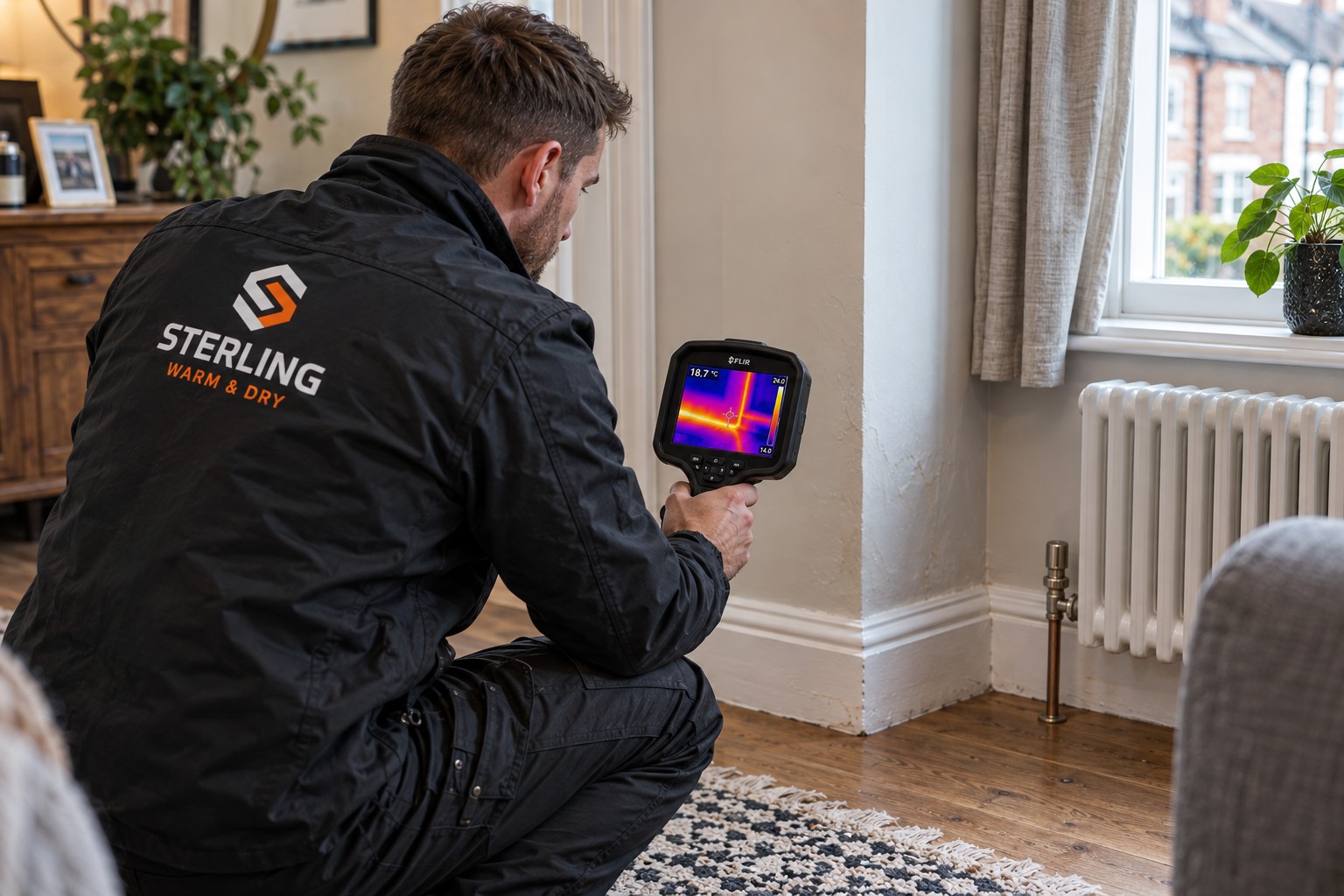
LEEDS
Why fast, evidenced drying matters in Leeds
With so much of the city's housing stock either converted from commercial use or built as dense terracing, water rarely stays confined to where it started. A leak on one floor of a mill conversion can affect the flat below before anyone notices; a wet terrace wall can mask timber decay behind old skirting. Sterling documents where the water has travelled, not just where it was first seen, so reinstatement in Leeds follows the evidence rather than guesswork.
Covering Kirkstall, Armley, Headingley, Chapel Allerton, Beeston, Hyde Park, Holbeck and the city centre.
Book / report an issueCOMMON QUESTIONS
Questions about this service
Does a mill conversion need a different approach to drying?
Often, yes. Shared structural floors, exposed brick or timber, and altered plumbing routes mean the drying strategy has to account for how water may have moved between units, not just the flat where it was reported.
Is my property in Leeds at flood risk from the River Aire?
It depends on location and the stage of the Leeds Flood Alleviation Scheme relevant to that area. River flood risk is separate from the plumbing and appliance failures that cause most of the water damage instructions we see across the city.
Can you deal with a leak affecting more than one flat?
Yes. Where water has affected more than one unit in a converted building, Sterling can coordinate investigation and drying across the affected units under a single instruction.
“A neighbour's washing machine leaked into our flat below and it wasn't obvious how far the water had gone. Sterling checked properly and the drying report was straightforward enough to send to the insurer without any back and forth.”
Michael · Homeowner, LeedsStart with the building problem.
Tell Sterling what you can see, when it started and whether water is active now. We can establish the most appropriate investigation or response pathway.
Book / report an issueCall 07415 909211